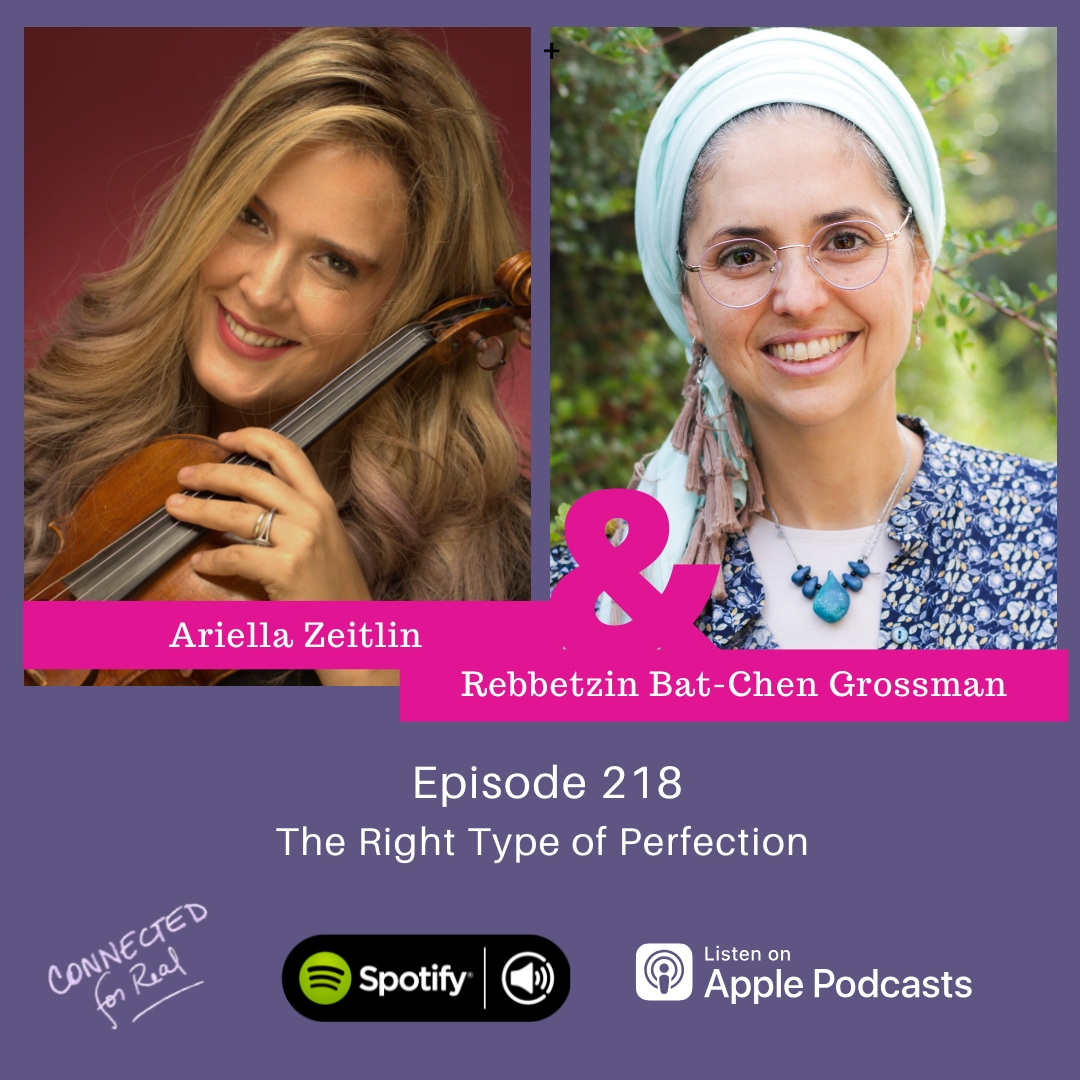

218. The Right Type of Perfection
Connected For Real Podcast
| Bat-Chen Grossman | Rating 0 (0) (0) |
| connectedforreal.com | Launched: Dec 22, 2025 |
| advice@connectedforreal.com | Season: 6 Episode: 218 |
Ariella Zeitlin is a classical violininst who is able to blend soulful singing and storytelling in her performances. Rebbetzin Bat-Chen Grossman is a marriage coach for women in business. Together they talk about Perfection and how you can practically become more prefect when you clearly understand the different types of pefection.
SUBSCRIBE

Episode Chapters
Ariella Zeitlin is a classical violininst who is able to blend soulful singing and storytelling in her performances. Rebbetzin Bat-Chen Grossman is a marriage coach for women in business. Together they talk about Perfection and how you can practically become more prefect when you clearly understand the different types of pefection.
Ariella Zeitlin is a classical violininst who is able to blend soulful singing and storytelling in her performances. Rebbetzin Bat-Chen Grossman is a marriage coach for women in business. Together they talk about Perfection and how you can practically become more prefect when you clearly understand the different types of pefection.
[00:00:00] Welcome to the Connected For Real podcast. I'm Rebbetzin Bat-Chen Grossman, a marriage coach for women in business. And my mission is to bring God's presence into your life, into your marriage and into your business. Let's get started.
And we are live. Welcome everyone to the Connected for Real podcast. Today with me is Ariella and I'm so excited because I love Ariella. We're gonna talk about perfection and you Ariella introduce yourself, and then we're gonna get right into it. Hello and good morning from Israel. Right now we're it's morning, so whenever you're listening.
My name is Ariella Zeitlin. I am a singer and violinist and performer and storyteller, and I just got back last night from a tour, a concert tour in South Africa, and I've been doing a lot. Of performing around the world, which is very, very cool. And so when said, asked me if we could talk [00:01:00] about perfectionism, I was like, oh, I have a lot to talk about.
So, so yeah. So let's get straight into it. Should we sell to, should we tell everybody how we know each other? I feel Sure. Go for it. Feel like let's kind of get into it. So, so me and Han used to be neighbors when I first got married and she was kind of a little bit further along that motherhood journey.
So she was my guru. She would like, taught me everything. She she said, you have to go swimming and you have to do water aerobics, and you have to, if you want the baby to get out, you have to walk. And, and then she was there at my birth and she came with me to the birth of my first daughter. And she came with me to the hospital and so, I mean, we've been connected for real, for a long time.
Yes. That, I mean, my daughter's 14 now, so it's just crazy like how time flies. Yeah. Yeah. So so that's how we know each other. Thank you. And that's who I am. And let's talk about perfectionism. Everybody. Oh my goodness. Okay, so lemme just give you a little bit of [00:02:00] a background. My podcast is built of four pillars, not only my podcast, my entire business, my whole life is is structured on four main things.
So God is at the core. Marriage and business are always working together or at least worth striving for that. And then you are the container of all of it. So, God, marriage, business, you are the four main things that I talk about. And I wanna make sure that they're all addressed because they're the things that have to always be addressed.
Absolutely. And so my podcast is, is built like that. So the entire month we've been talking about perfection. The first week was perfection in God, and you can go check that out. It was an amazing episode. Then we had perfection in marriage, and then we had perfection in business. And this week is perfection in you and you're sort of wrapping it up for everyone because there's.
So there's so much to say about perfection. Oh, we weren't gonna like touch on all of them because I've got, I've [00:03:00] got so much, I've got so much, I've got so much for all of those on all of those. So, you know what, before I get to meet, why don't I, I kind of talk a little bit for a second about perfection and God, because I think that I'm, I grew up in a very, very orthodox community and I am a very outta the box thinker and very creative and very not standard and.
Because I was, I mean, and I would even say that I'm on the spectrum of incredibly brilliant um, but growing up I always. Felt like I don't fit in and it's bad that I don't fit in. And I always was kind of ashamed when I would forget things or I didn't remember, or I, I did something that was wrong and, and and it ended up making me leave religion when I was about 11.
Deciding, you know, that this is it. I mean, you know, you're at that age and you're just thinking everything is black and white. And, and, and I've had a lot throughout the years, I've had a lot of shame that had to do [00:04:00] with the fact that I'm not a perfect Jew, that, that I would not remember things or I'm not good enough.
And then me and my husband were put into a Jewish leadership role where we moved to Herz, Leah, and he's in charge. And I was like, well, I can't. Even go near that. I can't be involved in that because I'm not a good enough Jew, because I, I just felt like I'm not a good enough Jew. And what's, what's funny is that over the past, kind of five years as I, like, I went through a lot of therapy and a lot of coaching and a lot of self-growth and like going really deep with my own like, relationship with God and.
And all of that. And I realized that being an imperfect Jew is actually way more impactful than being a perfect Jew because I, you know, I look at kind of these people who are perfectly quaffed and they speak so perfectly and. They're just not relatable for me. I can't relate. So I, I look at myself now and I think, wow, what a gift I am to other people when I say I'm not a perfect you and you're all [00:05:00] not perfect.
'cause none of us are perfect. So even the people who look from the outside, like everything is together, then there's often. Other things because we're not supposed to be perfect in this world. So I'm actually coming out now with an album in mid-February, which everybody's gonna love.
It's like all new songs, but it's a lot of that, of the I'm here and I'm here and I'm here to serve with what I have. And I, and, and a lot of, you know, mantras and manifesting and, and good messages that we want stuck in people's heads. 'cause then that's essentially what a song is. So. That's God, that's the, I love it.
And and then why not? I'll talk also about marriage is that I am married now for 15 years. And there's definitely that aspect that I always thought like, this is what a perfect wife looks like. And, and I kind of fell down this rabbit hole of being a perfect wife and that being somebody who is in service without thinking about themselves.
And I think that a lot of women can relate to that and can relate to [00:06:00] the concept and the idea that they kind of lose themselves in motherhood and in marriage. And it, and it ended up making my life hell. Because when, when you're not recognizing yourself as a, as a separate being and as a complete being, you're not acknowledging your own needs and your own desires, then you end up angry and resentful and mean and, and and, and even abusive.
And I was, and I, that really kind of set me into this spiral where, where, which sent me to therapy in Corona Times. Because, 'cause I, I was like, what? Like I've, I've become a person I don't recognize. I'm yelling all the time. I'm angry all the time. I, I was even hitting my kids. I like my, and I would say terrible things to them, the way that I spoke to them.
And I was like, who am I? Who have I become? I was this person who's full of light and happiness and joy, and now I'm a mother, and now I'm like a um, bad word. I was gonna say, said no, said no, no cursing. But I, I, I was like, I really became a person that I didn't recognize and I [00:07:00] didn't like. Right. So that was really what sent me on a kind of a healing journey.
And and today I can say, okay, you know, our marriage is probably different than everyone else's marriage. It fits, you know, totally differently. It looks totally different and we are figuring it out and we're learning to balance because I've chosen to live out this life with this person. And .
He's had to learn to live with the fact that if I'm gonna be a happy and fulfilled person, then that also means that I'm not gonna be at home and I'm not gonna be that woman in service. And that has been like a juggle because that's what he grew up with as. That was what his mother was like when he grew up.
And so that's been kind of a struggle that, you know, we're, we're always we're always trying to figure out, but I mean, he's a wonderful man and, and he's figure we're figuring it out together. It's not like I don't have a partner in this. So so that's marriage. Yeah. And perfectionism is that there's no such thing as a perfect marriage and that the point of marriage is that you're, you're saying, okay, I'm different than you and you're different than me.
And we share this [00:08:00] bond and we share this thing that we've built and we share this family and let's. Let's figure out how we can all get our needs met. And what was the third pillar? What did you say? God, marriage. Business. Business. Business. Okay. So business. This is a, I mean, this is kind of what we're gonna be talking about today, which I guess we've already kind of started talking about.
But my, my business is that I'm a performer and my training is that I am a very, highly trained classical violinist. So when I was in training, when I was starting. The, I mean, essentially when I, when I was training, I always thought that that was gonna be the business part of it, and. And when you're in this very intense, very high pressure classical music environment then perfectionism is literally crippling for everyone.
It's, you have to be the best. And if you're not the best, then you're, you lit. You have to be so much the best that only the best actually work. That's the way that it works in the classical music [00:09:00] world. 'cause there's so much competition and, it's just not, it's not possible. There's just not enough seats in the orchestra.
So, so, so that's, it's just this very intense, very high pressure environment. And all the time I was obsessed, obsessed, obsessed with perfectionism, and when I started moving into actually making money, which is essentially what we all want when we have a business, then I kind of realized that that perfectionism was the opposite of serving.
That perfectionism. When I go into someone's event or concert and I am obsessed with being perfect, then, then I'm not able to surf. You're so, perfectionism is really a function of the ego. Perfectionism is when I think I have to be perfect. I have to be perfect. I have to be perfect. Then you're not thinking, how can I serve?
And essentially all of us, every single one of us, that's. The way that we're supposed to be in the world. We're supposed to be in this flow state where things are moving through us, and we're here to teach people things and we're here to share things with people [00:10:00] and we're here to spread ideas and we're here to spread concepts.
But if I stand in front of an audience and all I can think about is how beautiful I have to be and how perfect I have to be, and I can't let them see my flaws, then they don't relate to me and I'm not serving them. And it's literally. The worst possible thing for everyone if I am stuck in my perfectionism, and that's been, I, I actually had a concert on Wednesday that I.
Walked in and it was way bigger than I was expecting. I thought that it was going to be something small in a synagogue, you know? He said, okay, we'll have a hundred, a hundred people. But I didn't think that they would put a lot of effort into the production. I walk in and there's this huge stage with screens and lights and this walkway and like a catwalk and, and I, and I had this moment of, I'm not.
I not good. I, I, I wasn't prepared. This wasn't what I was preparing for. And because I, I kind of prepared for a fun night where I was gonna be entertaining and we were just gonna have a good time. [00:11:00] And, and then I was like, well, if it's gonna be like this with the lights and the screens, and then, then I have to be, I have to be more perfect, then I'm prepared to be, you know, and I kind of got in my head and I.
Did the soundcheck and the whole time I'm like, I'm not, I can't do, I'm not prepared for this. This is not the, this is not the event that I prepared for, you know, in my head. Because essentially when we walk into a space, if we're ever doing public speaking or anything, we have a certain vision of what this is gonna look like, what it's gonna feel like, what it's gonna sound like.
So, so then I had to go, I walked my, I went out after the sound check and I kind of went into a room and I closed the door. And I reminded myself, I sat and I reminded myself, I said, Ariella, you are not here to be perfect. You are not here. That's not the point here. The point is that , there is a lot of people here and you have so much that you can share with them.
, if you're, get every word right and you sing every note perfectly and you play every note [00:12:00] perfectly, but they didn't, they didn't hear what you came to say. And, what's in your heart and, and how much I have to share. I have so much to share, so much joy to share, so much tools to share, so much coaching to share that.
That I'm just here as this channel from all the things that I've learned, all the good things that I've learned, all the ways that I've learned to, to improve my life, all the stories I've been through. 'cause I've been through a lot of really intense things that that, that actually have made me stronger and actually have made me more joyful and actually have, you know, I, I work with oh, sorry.
I'll get there Some here. Like, I realize a DH, adhd, she's like running off on a tangent, but. We love tangents around here. That's what it's all about. The point was that I have so much that I can give that doesn't have to do with make sure that you sh it's perfect. Right. And and I think that actually when it's not perfect, and I said this before, but I [00:13:00] kind of wanna just kind of nail that point in because I'm sure that there are people right now who are listening, who are, who are thinking, well, mm-hmm.
Maybe that applies to her, but it doesn't apply to me. Or maybe, you know, I, you know, I think that we, we often do that when somebody says that. I just wanna nail the, the point home is that as human beings, when we recognize that perfectionism is a function of the ego, and if we want to build businesses or, or if we want to perform, or if we want to function in the world, then we need to remind ourselves that.
Where you are right now. Right now, with everything that you have right now, you are worthy, you are valuable. You have what to share. You have what to give and, and that nothing, nothing you, nothing. You are a created being. This is right. We're talking about this is what we're, we are created. Nothing that you do will make you less worthy.[00:14:00]
Nothing, I think. Yeah, so good. So good. Nothing that you do will make you list. You will always be worthy. You are always going to be worthy whether you mess up in front of everyone, whether you fall on your face, whether you say something stupid, whether your clothing falls off and suddenly you're naked in front of everyone.
I'm just, you know, throw, you know, that's, you know, a nightmare. Then like, keep asking. Well now we all know what are our dreams about? I mean, just the point is that we show up. We show up to serve. We show up and, and with our businesses, and we show up to serve other people. And we have so much, so much that the world needs.
The world is desperate, desperate, desperate, desperate. Whatever you knowledge you've gained, whatever wisdom you've gained, whatever you've picked up. People are desperate for it. You, you know, you learn one thing and you, you're like, oh, that's something I'm gonna carry around with me. And we have this another ego function, which is that we don't think, we think [00:15:00] that if I've learned it, everyone else already knows it.
Mm mm Right? It's, it's, I, I, I learned a new concept and, and for the longest time I would well, I'm stupid, so if I learned it, then everybody else already knows it. You know, we have this, we're very mean to ourselves. I mean, I am, and I think that, you know, perfectionism comes along with being very mean to yourself.
And don't you have to like, you have to practice that self love. You have to like, sit with yourself and say nice things to yourself and. Just, yeah. Okay. That's, yeah, that's what, I love it. I love it. And it's really beautiful how you touched on all the pillars, because it is all so connected and so interconnected
I so tangled. You know, like our relationship with God has to do with how we run our business and our relationship with our marriage has to do with how we deal with ourselves, and it's all connected so deeply. And the way you said a perfect wife is, you [00:16:00] know, the fact that you even have a description or a definition to a perfect wife is in itself gonna ruin your life, right?
Right. Or a perfect Jew or a perfect, exactly. Christian or whatever related to yourself. 'cause I think that we all have this concept and I. As you know, as a musician, I think that because, you know, I, I was in such an intense environment that it's like, these are the good violinists and these are the bad violinists.
This is like the, the first violinists or the good ones of the, there's so much of that sorting out of this is good, this is bad, this person is, you know, worthy because they won competitions or whatever. And, and I remember, I remember when you were pregnant the first time. I, I love you so much. It's been so fun to watch you grow up.
I just have. That first, you know me. You're welcome. No, but really, it was so beautiful. I remember when you came over and you were like, I want you to be at my birth. And I was like, me, [00:17:00] out of all people in the world, why does she want me? And she's like, because you're such a good mom. I'm like does she really know?
So like, it's been, it's been so beautiful to watch you grow and I remember during your pregnancy, you were practicing for hours, like maybe seven, eight hours a day. What was it? I don't know. Right. So I, I I mean there, there's that also that, that there's the stories that come from your family, like what happened to your mother and what happened with your mother's first child or pregnancy or the story that you were told.
Right. So so one of the stories, I mean, one of the things that happened with my mother was that she was in college. And when she, she was pregnant with my brother and she never finished college because she went into labor the day before her exams. so I had in my mind, first of all, I dated my husband for a very long time because I said I can't get married until I have my bachelor's degree.
It was, I absolutely [00:18:00] no way, I have to have the paper in my hand because if I don't, if I don't then, then I'm, you know, then I might. I might have the same, I might repeat my mother's, my mother's story, my mother's pattern. And then I got, I was pregnant with my daughter and I was in the first year of my master's degree and, and just, it was all this pressure that I'm putting on myself because I'm living in this little bubble of a world, which once you step out of that little.
Bubble is, you realize how small it is. You realize how small that little bubble that you have been living in is. And you know, everybody, there's so much pressure in that little tiny classical world. But, but then you step out and, and you're like, there's an entire world out here. There's an entire world out here.
And I wanna tell a story about perfectionism. Which is, you know, it's just such a, it's a, it's just a good story with that, that connects back to all of this is that when I was 22, I got accepted to one of the most prestigious music programs in the world. It's called the Music Academy of the West.
And it's in [00:19:00] Montecito, California. And Oprah is one of the sponsors, you know, a lot of like big celebrity names. They fly musicians in from all over the world. And it's like a summer festival and, and people come to the concerts and the masterclasses and it's, it's a big thing in the classical world, which of course you've never heard of 'cause you're not in that world.
But for me it's like, ha ha ha, the holy grail of, like music programs. I got in, they flew me in from Israel. I went with another, friend of mine who was also a student of my professor. And so we get to this and we get to this program, and one of the things that they had as part of the program was that there's this big museum and the museum has concerts every Friday.
Now , I think that, and you had to sign up to perform at the museum. I think that, you know, they could maybe 10 people, maybe 15 people. So we all sign up to go and perform at the museum and we get there and there's no piano. So some of the people are pianists. So they, they can't perform at all.
But most of the people who were planning on performing were planning on performing music that involved the piano. Like if you play a violin piece, that you have the piano backing you up. So I just remember in [00:20:00] that moment having like a let's problem solve. So I said, okay. Does anybody have any pieces that they can play without piano?
No. No, no. And I had in my mind that I would play this piece. That, I thought I was very arrogant, so I thought that I knew it, but, and I, and of course I have to save myself for the end because the ego, we're serving the ego, and, and I'm the best, right? Obviously I'm the best. So, so, and I've thought of this idea of playing the solo pieces instead of playing with the piano.
So obviously I have to be the last one so that everybody remembers me and also so I'm so pretty. Whatever. I'm just saying that like, I'm in my ego, I'm like, I'm amazing. So you're amazing. No matter what. I just have to say, you're amazing. We're all amazing no matter what, but there's. Okay, I'll get into that in a second.
Okay. I'm saving this thought to the ego thought. Okay. Because I wanna finish the story. But, okay, so everybody does their pieces. And then I get up last and I start playing, and after I about, I dunno, 15, 20, 30 seconds, I, get lost. And also, nobody had their music with them, right? Because [00:21:00] everybody thought that they were going to play things that they knew.
So I get stuck and I start over and, and I get stuck again. I was like, okay, forget that one. And then I pulled out a different one a different piece that I was working on, which. Which was well it was an Israeli piece and it was, and and my professor afterwards was very angry 'cause he said, that's not ready to perform.
But at the event, because I messed up twice and then I played , this other one, everybody like stood up and gave me like a round of applause and people remember it to this day that I messed up and that I caught it and that I played something else that I knew better. People remember it.
People remember it because when you're in the moment and something messes up and you don't have all the cards lined up and you don't have everything, all your ducks in a row, people are like, okay, that's a real professional, a prof. Real professional is somebody who, who can figure out what to do when, when the circumstances are not ideal.
Mm-hmm. So now I wanted to say, what about the [00:22:00] ego and the difference between ego, perfection, and regular perfection? I mean, godly perfection, right. Is that perfection as, as a being. We are all perfect beings because we are made in the image of God. We are all perfect beings. Like the, the fact is that fact that you have a creative mind and that you can come up with new ideas and that, that makes you a perfect being because we're supposed to be in process and we're supposed to be learning all the time, and we're supposed to be growing all the time.
And that's just what makes us magical as human beings. But when we don't acknowledge that there's a source that we're connected to, that we're connected to this perfection, that I can be perfect and you can be perfect. When I say only I can be perfect, I am the most perfect. You are less perfect because I am perfect.
That is when, that's, that, that's bad. That's the ego that it ends up. And, and it also is a facade 'cause it's, it's not real. It's not real. What is real When we say I'm connected to source and I'm [00:23:00] channeling source and I am bringing all the goodness in the universe in order to share it, , but when I am not connected to source and I'm like just, I, just me, I am amazing.
I am the best. I am the most amazing and you all have to come and be impressed with my most amazingness. That is when we, we will mess up for sure. We will mess up for sure. We will beat ourselves up for sure. We will have imposter syndrome for sure, because I talk about, I talk about this all the time with people, I do a lot of coaching with artists like, right, so it's like I'm imposter, I'm not good enough.
I'm, I can't do this. And what is imposter syndrome? Yes. On the one hand, you're right, you're flesh and blood. You're dirt, you're you came from dirt. You're, you're gonna end up in dirt. Like you're right. You're just flesh. You're flesh and bones, but you're also source. So when you say that like, I, I, I, I, I'm not good enough.
You're right. You're not good enough. But you know who's good enough? God is good enough. And you know what else is good enough? Is God can, can send things through you. So if you say I'm [00:24:00] open to God sending things through me, then, then you're good enough. And not only are you good enough, but people come and they feel the energy and they're inspired by it and, and you don't even know what happened.
Right now I'm feeling it, like, I'm like, I'm in the zone. And I was like, an hour ago, I'm sitting on my couch. I'm so tired from like the trip I was like. I'm like, I, I'm surprised and I'm not even really surprised because I know that I get into this zone where I'm talking about God and I get passionate and things just kind of flow through me.
'cause these are the messages that the world needs to hear from me. But I don't think, oh, these are my messages. It's, it's, it's me. It's the things I've learned, it's the things that I feel true to me. So they stick with me and then I share them. I love how you made the, the, the real great definition of godly perfection versus ego perfection, because as soon as you said that, it suddenly became so clear that actually.
Like you said, we are all amazing. Right? You know when when you tell me I'm amazing, I'm like, I know I love you. You're amazing. But not [00:25:00] because you have made yourself amazing, but because you just are. And when you just are just like you said, worthy, you just are. Yeah. And if you just are, then there's nothing that could change it.
There's nothing that dependent on it. Nothing is going to affect the fact that you're amazing. Right. Unless you block it, right, which is what you were saying, like, no more, God, this is just me now. And then it's like, oh where's the flow? What's going on? You know, inspiration, where are the ideas? Why is nothing coming to me?
Because it's not, it's 'cause I'm, I've gotten stuck in my flesh and bone, little universe, of myself, right? So, yeah. Ugh. I love it. I love it so much. This is so powerful, so powerful.
Hey, before we continue the episode, I want to ask you something. Are you ready to get answers from God directly, feel more in love with your husband and more supported than ever? Run the [00:26:00] business of your dreams without having to sacrifice any other part of your life? That is exactly what my one-on-one private coaching is for, and I want to invite you, just you and me.
For a free deep dive discovery call, this is a 60 minute free call where I ask you lots of questions and we extract the three main things that are holding you back. I then put together a personalized plan for you where I create a roadmap of recommendations. With practical steps, the call is free and so valuable in itself.
So go book yours today. Now back to the show.
Let's talk about what we do to ourselves when we. I try so hard to be the thing that we're not, you know, like you were saying, I'm a D adhd, I'm all over the place.
I go on tangents. I'm like, me [00:27:00] too. I dunno. Anybody who doesn't. Yeah. Yeah. And we beat ourselves up because. For some reason, we've been made to feel like it's not supposed to be that way. You are supposed to be a robot. You're supposed to be able to speak without saying ums or like, or anything that doesn't fit in, you know?
Right. Things like that. Why? Why do we believe that and why is it so hard for us to just accept ourselves the way we are and use that to our advantage? Right. So, so I think that, I think that the whole concept of A DHD and not being able to, you know, stick to a topic and kind of going off on tangents, you're right, it's, essentially it kind of fits into the ego versus flow.
Because if you're in a flow state, then things are just flowing, right? Your, your mind sends you in this direction, okay, we're gonna flow in this direction. Okay? The ideas are coming this way and we're gonna go this way. As opposed to if I am a professor and I have prepared a, this is what we're talking about [00:28:00] today.
It's, it's kind of limited what happens if you come up with other ideas and, okay, wait, but we're not, we're not thinking about those other ideas. And sometimes that, I mean, those ideas can be divine divinely inspired. Right. Right. So that's part of also why, why we, like in general, as human beings, we like podcasts so much because we're listening to real conversations as opposed to lectures.
Mm-hmm. Which you're going to in order to receive knowledge. And what's very nice about receiving knowledge is that if somebody does it well, then it's very organized. And then, you know, the idea stick in your head, oh, here's five things that will, five ways to improve your marriage. And you're like, okay, here are the five ways, you know, and I kind of walked away with my five.
With my five ideas. So so there's definitely, I mean, there's definitely benefits to both. There's finitely benefits to coming to something that's prepared and organized. And then there's also definitely benefits to feeling like you're in the room with the people and you're listening to the conversation that they're having and, and Okay.
That's the way I think also. And oh, and it's, it's a little they're [00:29:00] both interesting. It's, it's just. Two parts of humanity and yeah, you know, I used to be, I used to be so into that flow and the go with the flow and the flexibility and this like, you know, spontaneity that I didn't want to have structures like you see, my podcast is structured in a way that actually works for my personality because it gives me a framework to sort of focus me.
But I built it so that it could help me have that flexibility within the framework or my four steps to creating flow, which is the calm method. Once I created it and once I sat down and really got that download, it's totally divine. 'cause I could not have done it better. It's like blows my mind every time I teach it how helpful it is to people.
It's. It's something that I have in my back pocket that if I need to talk about what is the way to create flow, I know I'm going to be able to [00:30:00] teach four steps, going to stick in people's minds and I know what I'm going to say, but sometimes I say different things, you know, to different people. And sometimes I go on tangents or I think of examples that aren't the same examples as I gave last time.
And I think that's what makes it so interesting. Yeah, I, I think that that's great when you have kind of a general structure and then you, okay, let's talk about this thing. Okay, now let's talk about this thing. Now let's talk about this thing. Yeah. Yeah. I think that helped me be consistent. 'cause also another thing that I believed about myself in the past is that I'm not consistent.
And now I just had to do this journaling prompt that my coach sent. And it was like all the ways I'm consistent and I, I couldn't stop 'cause I was so consistent about so many things. But it's not things you give yourself credit for. Like, I eat every day, you know, I sleep every day. I'm super consistent about regular things.
I brush my teeth every day, but, oh, but I'm not consistent. Why do I believe that? You know, and there's, there's something that made me feel that. [00:31:00] I mean, I, you get dressed every day. You wear, you know, you wear the, the headscarf every day. That's very consistent, you know? Right, right. Consistent. You're right.
We have lots of things that we, it's just whether or not we built the habits or not built the habits. I think that, you know and it's, it's deeper than the habits. I feel like it's the belief about yourself. You know, there's perfection is going to make you feel like you're not there yet. Or you're not worthy because you're not there yet and you need to be there in order to be a certain thing.
So you're not consistent if you can't get exercising every day or you're not consistent if you can't do this, that or the other. And it's like but I am consistent in other things. So what is holding me back from feeling like this is true right now? Yeah. Yeah. I definitely. Yeah, I, I'm like thinking to my own kind of thing.
And this is, that's actually something that I really got into my own head about. I'm thinking about with social media was you want to post every day. So then, so then when I was not [00:32:00] being, when I've not been consistent with it, then I kind of beat myself up. I'm supposed to be consistent, I wanna be consistent, and I can't.
And then I came up with a system and I hired somebody to like. Keep the, keep the post flowing and, and I was like, oh, I just needed a better system. Right, exactly. Oh, you could be consistent if you just have a better system. And yeah, so I think that that's also really important. I think systems are what can save a person who has a DHD.
Absolutely. From themselves, from like beating themselves up. Can I tell, can I tell you a system that that I discovered , which I just came back right from South Africa, and usually I have my suitcase and I fold my clothing and my suitcase and, and then I travel. But then I get very overwhelmed when I have to unpack because, 'cause everything's, and, and I, and I bought these packing cubes that they're like, they're these you know, soft things with the zippers and then everything is categorized.
And I think that that. Also for the A DHD brain is that the smaller the category is, the more it fits into a category, the easier it is [00:33:00] to kind of go according to the category. And I also think that the A DHD brain. There's, there's certain things that are just, you never learn the skills. A lot of people didn't learn the skills on how to have an organized mind, because I think that a lot of that stuff is, is taught and I think that we, a lot of us are just un not undisciplined, intentionally, but I think that maybe we weren't raised.
In a home that they taught us how to do that, or they were able to see that, okay, this child needs help understanding the concept of organization and how can we keep working on this on a very consistent basis. And the more that I've invested in being organized, the better my life has become because the chaos ends up also having a shame cycle because you have a shame around the chaos, .
But it also, it becomes hard to find things. It becomes hard to do things or remember what you wanna get done that [00:34:00] day. The more organized that we become. The better our lives become For sure, for sure. And, and, and the more honest we are about what our needs are within the framework of that chaos is when, you know if I, I need, you need to eat right. But a lot of people with a DHD end up not eating. Right. And then, and then you end up tired and overweight and maybe overeating also because you're in this, I, I didn't set up the system to eat. That's something that, you know, over the past couple of months I started eating more.
And I had, I like, I, oh my gosh, I feel like a human. I'm, I thought I was so tired and I'm feeling so old, and it just has to do with eating and, and maybe you're eating once every three days because you're forgetting and you're in, like the, and I prioritize eating and I lost like 35 pounds. And it, I didn't really change anything except for that.
I started eating right, and then your brain is working better, and then your muscles are working better. [00:35:00] Everything is falling into place. And you're like, really? It was just that, but yeah, totally. I think also the fact that I have this belief that it has to be consistent or perfect, or I need to do it this way because that's how other people do it.
Right. Has been. So detrimental to my own organation. Oh, detrimental, right? To my own, my, my own way of doing things, right? So, and if I, if I decide that I wanna do something, or if I wanna be consistent about something, or I wanna create a new habit and I mess up, right? So this is the kind of like the all or all or nothing thinking, right?
I, I'm gonna diet, I'm eating a certain way, I don't eat. Gluten, let's say, or I don't eat sugar and then I'm at something and I end up eating something with sugar. I'm like, okay, that's it. Never again. Like I'm not, I'm not, I'm not on the diet anymore and I had, I used to have this blacker white thinking a lot, you know, I would, I would be, okay.
I'm so strict about what I'm eating. I'm so strict about being on keto and or for, for example, 'cause there was a while that I was on keto and then I had one day that I ate [00:36:00] something that was, I dunno, potato or whatever it was. And then I, and then I couldn't get back on, I couldn't get back on because in my mind I was like, okay, you are or you aren't.
But the fact is that. The more we forgive ourselves and we just say, okay, I, I, I needed that at that moment. And I'm going back to the thing. There's no such thing as perfection. We're all in a process. Mm-hmm. We're all in process. There's nobody is going to be perfect all the time.
Nobody, and, and the truth is that yes, maybe I think the food thing is like a really good example because when we eat well and consistently, then we feel really good and our brains work really good and we just function better as human beings. But that doesn't mean that you have to throw everything around out the minute that it doesn't work for you for a day or whatever it is.
Right. I love that you're talking about the, the practical things, because really for all of our listeners, they know it all in their heads. They're like, perfectionism is ruining my life and I need to blah, blah, blah. And even that, [00:37:00] like, I need to, nobody's making you, you want to, you want to feel better, so.
Make sure you eat and make sure you make yourself a system for what you're eating when and what's available for you and who's feeding you. You know, like for me, my husband makes me breakfast every single morning because I have said this on my podcast before. It's very, you know, slightly embarrassing to think like, oh, you can't feed yourself.
But I want to get the kids outta the house. I want to do the things I need to do. I wanna pray in the morning, and then by the time I get to making food. I don't really feel like cooking anything. I'll just, so I'll just look around to what there is already and then I'll grab whatever there is. Yeah, yeah.
It's not good for me. So my husband makes fish and jumped vegetables every single day. Jump vegetables for all you non, non batan people is the vegetables that are saute. Because, because when they're jumped right? They like, get this nice yeah. Yum. Yum. So every single [00:38:00] day I have. Fish in the morning with vegetables and I actually have a real meal, and then anything I eat from that point on is extra.
It's like nice bonus. Yeah. I, I totally agree. I also like the minute that I started prioritizing breakfast, it's just, it changes everything. It changes the way your entire life works. And also, I started doing something that I heard in a podcast about women's health is that I, I have, right when I wake up within like the first 20 minutes, I have three Brazil nuts.
Hmm. It's very important for women in our metabolism and I, and obviously this is another tangent, but it's very important for women to eat right away when they wake up. Like really right away and get those healthy fats. I eat three Brazil nuts and that was also part of whatever I, like I said, I had a 35 pound weight loss and I worked with somebody to kind of get me understanding that I have to keep eating.
Right. Because if not your body is in this war. Yeah. There's more, there's famine. Yeah, exactly. Your body freaks out and and so many of us are not consistent around food. And okay, [00:39:00] fine. Whatever. We're never gonna be perfect beings. Like, that's not the point. Yeah. I once, I once had, there's this guy here who's very into health and, and healing and all that great stuff.
And anytime he gave any class, he would start the class by saying 80 20 rule. If 80% of the stuff you eat is let's say whole grain and lower sugar and intake and whatever it is, then give yourself permission to have the 20% junk. Because your body is going to be able to deal trust your body's system that it can deal.
The 80 20 rule is so great because it gives you permission to sort of like, have healthy things available at a home. But also when you go out of the house, you could eat whatever you want or allow yourself to fluctuate through all the different foods without feeling that guilt or, you know, and I think that that fits in with business and it fits in with us, and it fits in with our perfectionism.
So we're saying, okay, and, and what happens when you have a slow day, right? Like, we're like, [00:40:00] I'm a per, I'm a perfectionist. I have this goal. I, I need to create this. Ecosystem or whatever. Whatever the thing is that I'm trying to create, I need to create it. Right. And what happens, you have a day that like you're not as, as on as you are.
You know, you're not as functional, you're not as like going and you don't have as much drive. Okay, fine. You know, like as long as it's not, I mean, as long as it's not, and, and even if you need a few days, right? Sometimes we need a few days to kind of decompress or to kind of to rest or, you know, don't.
Don't allow yourself to get pulled into the trap of I should or I need to. The more that we get intuitive and we listen to ourselves and what do I need and what, what do I need in order to support myself? The faster we get healthier when we're sick, the faster, you know, the faster things flow for us.
Because we have to be clear. We have to be clear. And it's okay to [00:41:00] say I can't make a decision now, and I, you know, I, you can't, we can't be perfect without time. Right? Like, I'm, I'm saying we can't ever be perfect, but like the, the, sometimes we need time to rest and we need time to process and don't just never.
Never allow yourself to get pulled into the shaming of yourself for not being perfect or not fitting into the box of, of perfectionism that you've created in your mind. Because Yes. 'cause we all need different things. And we all also function very differently in terms of energy. You know you know, we, I, I talk about this a lot, about how women were cyclical, right?
We have different times of our month that we're like on and other times that we're totally like, we really need to rest. And men are kind of a little, they're a lot more consistent, right? But, and even within women, okay? So some people are more this, more that. And so the more we learn to respect the fact that perfectionism doesn't exist, there is only [00:42:00] what do I need in order to support.
This being that is me in this universe. What does this body need? What does this body need? What does this soul need? What does this what does this human need? What do I need from my relationships? What do I need from my business? What do I need from my children?
What do I need from God? And I think that, you know, that that kind of, that's the way that, that's the opposite, right? Of the opposite of like the perfectionism. What do I need? And how can I support myself to continue to, to do this thing that I, that I believe in or that I want? And, and it's, and it's all of, it's okay.
And just kind of, kind of recognizing that it's all okay. It's, it's okay to need rest. It's okay to take a break. It's okay to sometimes eat junk. It's okay to, you know, everything is okay, what is the thing that you are the most coming back to that this is important. And this is, you know, getting recentered and, okay, this is important to me.
This is, this is what's [00:43:00] important to me. And just kind of, and just going for it. And if it doesn't come out perfect, then try again. Right. I love that. If it doesn't come out the way you want and try again, try again. This was amazing, amazing. I'm sure we could keep talking about it forever, but I really love how you've wrapped up perfection for us and especially now, you know, we're in this season of Hanukkah and everything is sort of like lighting up the world for you to be able to light up.
You cannot hold yourself down with perfection. You really have to let go of anything that isn't serving you and. Trying to spend three hours on some little detail that maybe isn't even necessary, is not going what, maybe not even important. Yeah, exactly. And that's usually what trips us up.
So let yourself do things messy and just go for it. And I think that's really going to be where things start to really shine and, break [00:44:00] through. Thank you so much. I'm so glad that we worked this. By the way, I also wanna say to everyone as we're closing this up, we messaged me and she said, when can we do a podcast?
And she's like, how about right now? How about, how about right now? And I was like, I, I don't know. I just, you know, I just got home. I just get, and right now 'cause, because, because the kids are gonna go on now is better. Jumping on something now is better than saying let's do it next week and let's do it a month from now.
Or maybe, you know, sometime in the future, this is what I wanna talk about. Get on the call now. And I was like, okay, okay, let's do it. But I'm so glad that we did. I'm so glad we did because, because, you know, perfectionism is just, it's doesn't exist. Yeah. Can you imagine if I made, if you like, thought you'd have to prepare and you'd have to think it through like this golden stuff would not have come out if you had to brain it, you know?
Yeah, I love it. How can people [00:45:00] find you? So I am Ariella Zeitlin music on Instagram and Facebook and TikTok. Ariella zeitlin.com. Z-A-R-I-E-L-L-A-Z-E-I-T-L-I-N. Most of what I share is music and I also share sometimes like coaching stuff and ideas, you know, kind of along these lines. And, yeah. And I've got lots of music on Spotify too, so if you like the violin, there's lots of music out there. Yes. And you are good. Thank God it's all from hash jam. But you did a great job practicing. I, I remember. Thank you so much for being with us and thank you for listening. Don't forget to be connected for real.
And that's it! Thank you for listening to the very end. I would love if you can leave a review and subscribe to the podcast. Those are things that tell the algorithm this is a good podcast and make sure to suggest it to others. Wouldn't it be [00:46:00] amazing if more people became more connected for real? And now take a moment and think of someone who might benefit from this episode.
Can you share it with them? I am Rebbetzin Bat-Chen Grossman from connectedforreal. com. Thank you so much for listening and don't forget you can be connected for real.